
Grinding equipment serves as the core "heart" determining processing performance in the full mineral processing line.
Many mining enterprises devote massive energy and budgets to separation processes such as flotation and magnetic separation, yet overlook a key fact: grinding technology accounts for 70% of mineral recovery efficiency. Whether valuable minerals can be fully liberated from gangue directly impacts the concentrate yield and tailings loss in subsequent separation procedures.
I. Where Is the Bottleneck of Traditional Ore Grinding?
First, clarify the fundamental goal of grinding: to liberate valuable minerals from gangue impurities and thoroughly separate coated or intergrown metallic and non-metallic minerals in raw ore.
Qualified grinding results need to meet two standards simultaneously:
✅ Under-grinding avoided: Ore particles are fine enough to fully separate valuable minerals from gangue without locked particles;
✅ Over-grinding avoided: Prevent excessive ultrafine slimes that cause valuable mineral loss in tailings and raise separation difficulty.
This constitutes the core challenge of mineral processing. Traditional ball mills struggle greatly to strike a balance between the two standards. For one thing, ball mills crush ore via falling steel balls driven by rotating cylinders. Most energy is wasted on cylinder rotation and ineffective collisions of grinding media, leading to an effective energy utilization rate of merely 20%–30%. For another, discharge from ball mills features a wide, uneven particle size range with both under-ground and over-ground particles coexisting.
Another major headache for concentrators is that grinding usually consumes 40% to 70% of total processing energy. As easily processable ore resources dwindle, complex refractory ores featuring low grade, polymetallic intergrowth and fine dissemination grains are growing prevalent. Traditional ball mills are increasingly incompetent for fine and ultra-fine grinding tasks.
II. How Does ISAMILL Solve Pain Points?
Widely recognized as an ultra-fine grinding mill across the global mining industry, ISAMILL revolutionizes mineral processing by delivering grinding fineness below 10 microns, unlocking ore bodies previously unprocessable.
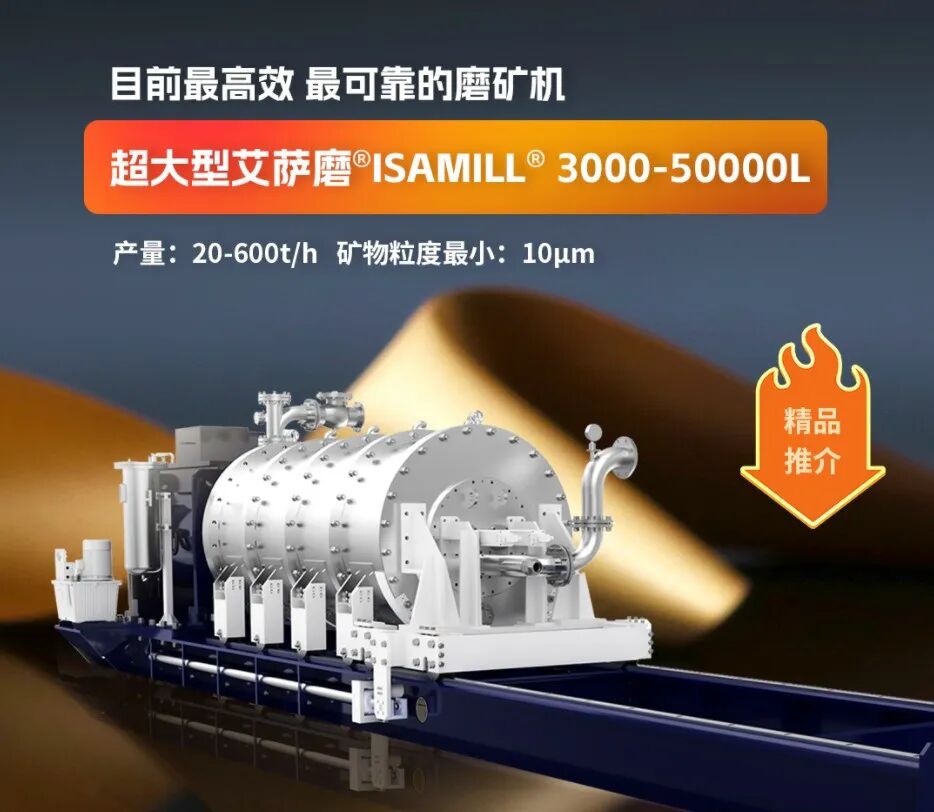
Targeting cutting-edge global mining equipment technology, Puhler Nano has independently developed extra-large mining-specific ISAMILL® (3000–50000L) based on over 20 years of overseas industrial application experience. The product breaks foreign core technology monopoly in large-scale high-end ultra-fine grinding equipment.
Working Principle: A Revolution from Falling Impact to Agitation Shearing
The extra-large ISAMILL® mainly consists of a grinding chamber filled with grinding media and a rotary agitator equipped with eight stirring discs and a product separator. Driven by the main shaft, the stirring discs rotate at high speed with an outer peripheral linear velocity up to 23 m/s and a power density of 300 kW/m³, far exceeding the 20–30 kW/m³ of traditional ball mills.
Instead of being crushed by falling steel balls, mineral particles are refined through attrition force generated by high-speed grinding media (2–6 mm ceramic beads). An independent grinding zone is formed between every two stirring discs. Driven by feed pressure, ore slurry becomes finer as it flows forward — this is the secret behind the built-in centrifugal classification and open-circuit grinding design of ISAMILL®.
This brings a key advantage: complicated external classification equipment such as hydrocyclone clusters is no longer required. The overall processing layout is simplified, cutting investment and maintenance points for auxiliary machinery.
Selective Grinding: Targeted Particle Milling to Eliminate Over-grinding and Under-grinding
The ISAMILL® adopts a selective grinding principle: large media grind coarse particles, and small media grind fine particles. Multiple independent internal grinding zones combined with high-speed agitation enable mineral particles to receive precise shearing force from small-sized ceramic media, producing finished products with a narrow particle size distribution.
To illustrate with a simple analogy: traditional ball mills work like smashing walnuts with a sledgehammer — either coarse particles get crushed while fine ones remain intact, or fine particles are over-ground while coarse ones are not fully liberated. By contrast, the ISAMILL® delivers targeted grinding similar to screening with graded meshes. Coarse particles are processed by large grinding media and fine particles by small media, achieving accurate, efficient and well-classified grinding.
A narrow particle size distribution greatly improves flotation performance. Industrial test data fully validates its advantages. Adopting Puhler’s extra-large ISAMILL® open-circuit grinding process, the fineness of ground ore reaches 98.17% for particles below 37.5μm, and the gold grade of cyanide tailings drops from 1.55 g/t to 1.04 g/t.

Test Results, Power Consumption & Media Wear Indexes(a) Steel Balls, (b) Alumina Ceramic Balls
Energy Saving & Consumption Reduction: Substantial Energy Cut Instead of Minor Savings
Its energy-saving performance is outstanding. The 3 mm ceramic media used in ISAMILL® boasts over 20 times larger specific surface area per unit volume than the 50 mm steel balls commonly adopted in ball mills. A larger surface area means more frequent grinding contact between mineral particles and media, delivering a 60% higher grinding efficiency and over 40% comprehensive energy saving versus traditional ball mills.
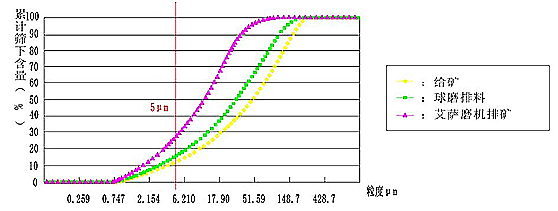
Grinding Performance Comparison: ISAMILL vs. Ball Mill
With the same ore throughput, the cylinder volume of ISAMILL® accounts for less than 20% of that of a conventional ball mill. Featuring a horizontal layout, the equipment has a controllable overall height, greatly lowering requirements for factory height and floor space.
Equipped with an intelligent control system, the machine adjusts the agitator speed in real time via frequency conversion according to feed conditions and target particle size, stabilizing product quality and keeping the unit operating at optimal energy efficiency.
Iron-Free Grinding: Optimize Flotation Conditions and Raise Concentrate Grade
Conventional ball mills utilize steel balls as grinding media. Continuous abrasion releases iron into ore slurry during grinding, resulting in iron contamination. This exerts devastating impacts on subsequent flotation: iron ions consume flotation reagents, degrade separation environments and reduce concentrate grade.
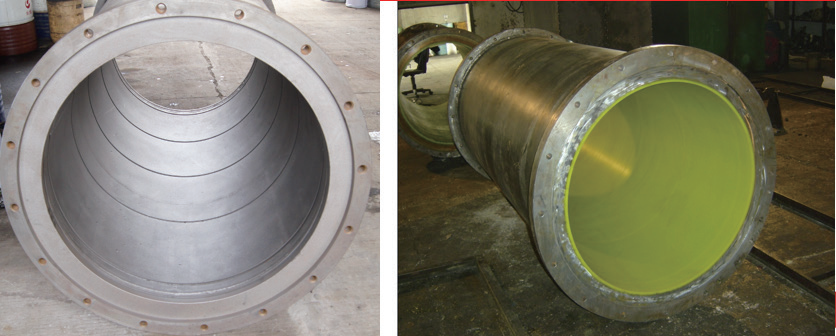
Puhler’s extra-large ISAMILL® features cylinders, stirring discs and main shafts fully lined with rubber or wear-resistant PU coatings wrapped in rubber sleeves. Paired with ceramic grinding media, it achieves zero iron contamination throughout the grinding process. This not only optimizes flotation conditions to lift concentrate grade and recovery rate, but also eliminates reagent waste and separation efficiency loss caused by iron pollution across the whole mineral processing flow.
III. Application Scenarios: Which Mines Should Prioritize ISAMILL®?
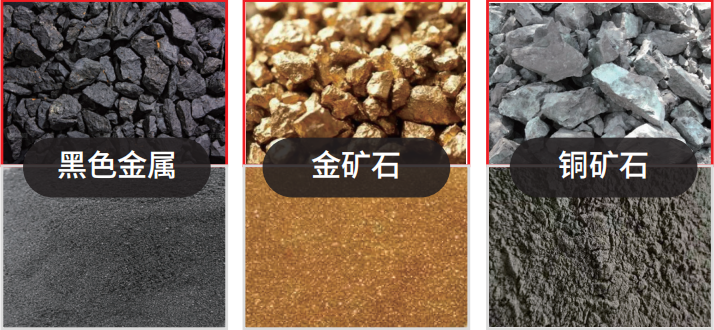
ISAMILL® is suitable for fine and ultra-fine grinding of more than 200 types of ores including copper, gold and iron ore:
Gold smelting: Boost gold output and cut gold grade in cyanide tailings
Non-ferrous & ferrous metal concentrators: Improve concentrate grade and recovery rate
Polymetallic intergrown ores & finely disseminated ores: Realize effective mineral liberation
Metallurgy: Integrate grinding and leaching to raise processing efficiency
At present, Puhler’s extra-large ISAMILL® has been adopted by well-known mining enterprises such as China National Gold, Zijin Mining, Shandong Gold, Tianbao Mining, China Zhongjin Lingnan and Chihong Zinc & Germanium. The equipment is also exported to international markets including Russia, Laos, Zimbabwe and Namibia.
IV. Core Conclusion from Equipment Manufacturer:
Reliable Recovery Starts with Proper Grinding Setup
Many mines fall into the misunderstanding of prioritizing separation over grinding. They keep upgrading flotation and magnetic separation equipment while ignoring that grinding lays the foundation for mineral processing. Even state-of-the-art separation machinery cannot deliver ideal results if valuable minerals fail to be fully liberated.
Puhler Nano’s extra-large ISAMILL® (3000–50000L) brings a brand-new technical solution to the industry. Instead of simply scaling up traditional ball mills, it adopts an entirely different working principle to achieve far more efficient grinding.
If you are troubled by any of the following issues:
• Persistently low recovery rate and severe metal loss in tailings
• Insufficient grinding fineness and incomplete mineral liberation
• Excessively high energy consumption and mounting production costs
• Severe over-grinding slime that deteriorates flotation conditions
Puhler Nano’s extra-large ISAMILL® is well worth your consideration. We adopt a full-service workflow: process formulation first, equipment selection second, precise commissioning and customized production. Tailored grinding systems are designed according to clients’ ore properties, throughput requirements and site conditions, fundamentally boosting mineral recovery, cutting energy consumption and lowering operation & maintenance costs.
Contact: 13928869344
